
A biblically faithful church is a church that has the following eight characteristics: 1) oneness; 2) holiness; 3) catholicity; 4) apostolicity; 5) the true proclamation of the Word of God; 6) the right administration of the sacraments; 7) the faithful exercise of church discipline; and 8) loving community.
During the struggles of the early church, it sought to clarify the essentials of the faith in a series of councils that began at Nicaea in A.D. 325. The framers of the Nicene-Constantinopolitan Creed A.D. 381 (the second of the early Church Councils) recognized four characteristics that needed to be expressed as marks of the true Church, and thus these four received creedal and conciliar sanction. These four characteristics, expressed in the phrase of this historic creed, “And we believe in the one, holy, catholic, apostolic church,” became increasingly common in the ancient and medieval church as descriptions of the true church.
Oneness
The Church is one by virtue of its union with Christ. All its members are baptized by one Spirit into one body having one Head and one Lord. “There is one body and one Spirit, just as you were called in one hope of your calling; one Lord, one faith, one baptism; one God and Father of all, who is above all, and through all, and in you all. (Ephesians 4:4-6). The Church’s oneness is both an objective fact and an ideal we are to pursue. In other words, the Church is One objectively because of what Christ has done for His Church and the relationship between Him and His Bride. Yet the Bible exhorts us to live in ways consistent with this objective fact as we pursue and maintain unity in the Body of Christ. (cf. Romans 15:5-6; 1 Corinthians 1:10-13; 12:12-13; Ephesians 4:3-6).
Holiness
The term “holy” means “to be separate,” or “to be set apart.” The Church is holy in the sense that it is separate from the world (i.e., the world system) and set apart unto Christ. The Church is definitively holy in an absolute sense in that it is “in Christ.” “It is progressively holy in a relative sense in that its sanctification is progressive, originating from the inner man and finding expression in the outer life.”
Catholicity
The term “catholic” means universal. Too often, people in the modern church associate this term with the Roman Catholic Church, which is not the correct understanding. The Church’s catholicity, or universality, is to be understood geographically as well as historically. The Church consists of all (not confined to one nation or location) who profess the true gospel, along with their children, and those in times past who professed the Christian faith. It extends beyond denominational boundaries and secondary distinctives. Churches that are exclusive in their membership, or those who narrow the door of church membership beyond what Christ does in His universal Church, are guilty here. Messianic Churches might be one example. Some “baptistic” churches are also guilty here.
“There is neither Jew nor Greek, there is neither bond nor free, there is neither male nor female: for ye are all one in Christ Jesus.” (Galatians 3:28; also cf. Ephesians 2:14-22).
Apolostolicity
The Church’s apostolicity refers to adherence to the apostles’ doctrine. “And they continued steadfastly in the apostles’ doctrine . . .” (Acts 2:42). Apostolic means to be in the discipleship of the apostles and under the authority and instruction of the apostles. In other words, faithful adherence to the apostles’ doctrine is what guarantees the church’s apostolicity. The principle was not intended to mean an unbroken chain of succession of bishops back to Peter as the first Pope.
For several reasons (non-scriptural), the bishop of Rome increasingly came to be viewed as the “first among equals” with “primacy and power” within the hierarchical structure of the medieval church. With this shift, the church of Rome came to interpret the attributes of the church institutionally: that is to say, the church’s unity was defined in terms of the church’s submission to the pope as the one Vicar of Christ in the world; the church’s holiness was said to be both the holiness of the sacramental grace invested in the sacraments, particularly in the Mass; the church’s catholicity was affirmed as the church claimed as its possessions wherever the flags of Spain and Portugal were planted; and the church’s apostolicity was interpreted to mean the apostolic authority of the pope which he purportedly gained through the direct unbroken apostolic succession back to Peter who was seen as the church’s preeminent bishop.
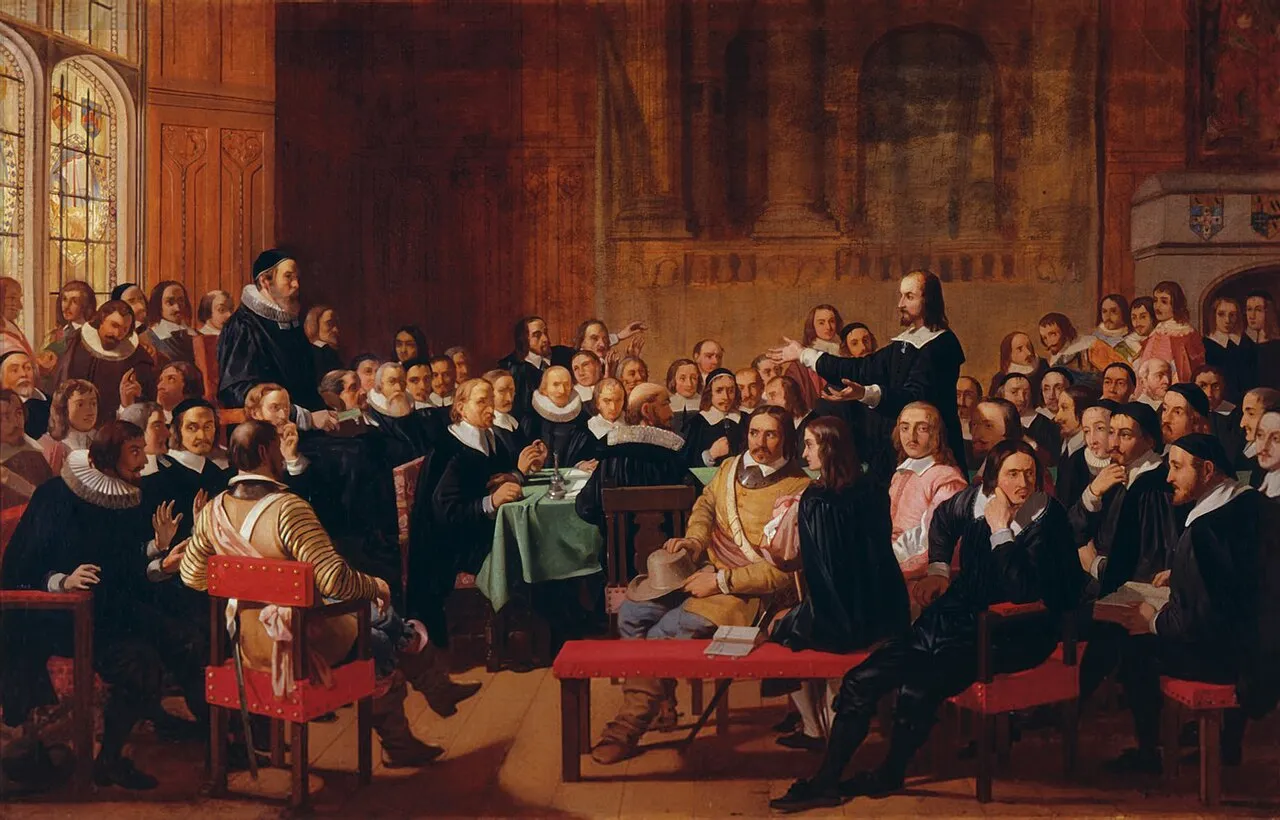
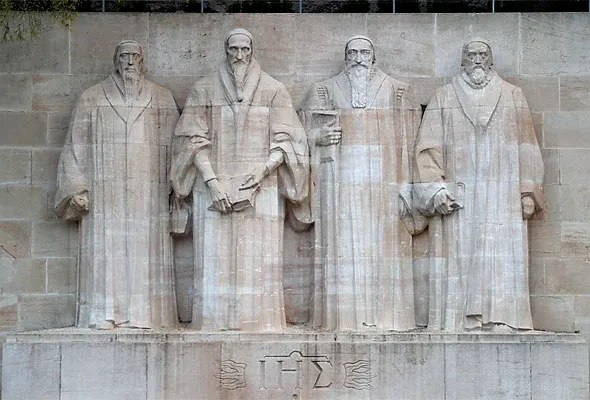
Due to the blurring of these four attributes by the maligned interpretations that the Church of Rome gave these characteristics, the Reformers urged that three additional marks distinguished the true from the false church.
Three Marks of a True Church
Since the Reformation, the Church has further clarified what makes up a biblically faithful church. The clarification of a biblical church has been articulated as one in which three principles co-exist: 1) the biblical preaching of the Word of God; 2) the right administration of the sacraments; and 3) the exercise of church discipline. All three of these correspond to the offices of Christ as He exercised His headship in His Church. Christ has the offices of Prophet, Priest, and King. Christ prophetic office is accomplished through the preaching of the Word of God. Scripture tells us, in the worship service of the church, Christ is the true preacher and worship leader. Speaking of Christ, the Bible says,
For both He who sanctifies and those who are being sanctified are all of one, for which reason He is not ashamed to call them brethren, saying: “I will declare Your name to My brethren; In the midst of the assembly I will sing praise to You.” (Hebrews 2:11-12)
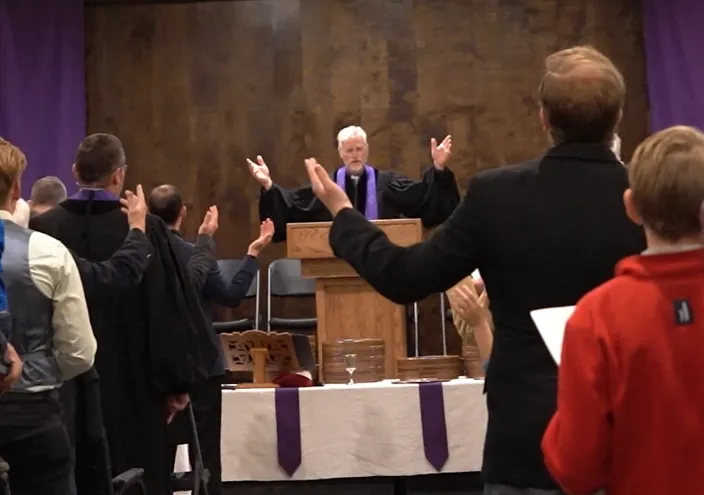
When an ordained elder preaches the word of God to the church, the Scripture says that Christ is the true preacher and worship leader in that worship service. This is how Christ performs His prophetic work in His Church. When a minister administers the sacraments to the Church, this corresponds to Christ’s priestly work in His Church, and when the Church properly disciplines its members, this is the expression of Christ’s kingly work in His Church. Principally, all three of these graces must be present in the Church for the presence of Christ’s ministry and office to be properly exercised within her. A church that does not uphold all three of these essentials is on the path to becoming an unbiblical church, and eventually a synagogue of Satan (cf. Revelation 2:9). At Heritage, we strive to uphold these three principles so that Christ’s mediatorial work is present among us.
A Loving Community
Heritage Church’s ministry is a family-integrated, multigenerational, covenant community. We seek a well-organized but simple ministry where the “one-another” principles of Christian living can be lived out. We believe the church is organic and thus will grow organically as the gospel life is nurtured and cultivated. We believe our children are a key part of kingdom growth, and we desire to nurture them up in the nurture and admonition of the Lord. We believe in evangelizing the lost and making disciples of the Kingdom. We believe that the gospel is extensive and that all of culture should be influenced by it. Therefore, we seek to influence every area of life around us (e.g., the character of men, the economy, politics, music, art, etc.) through involvement in our community. We hold that the civil magistrate is God’s minister for good, and therefore, we do not retreat from its institution. We pay our taxes and pray for those in authority over us.
Share This Article